
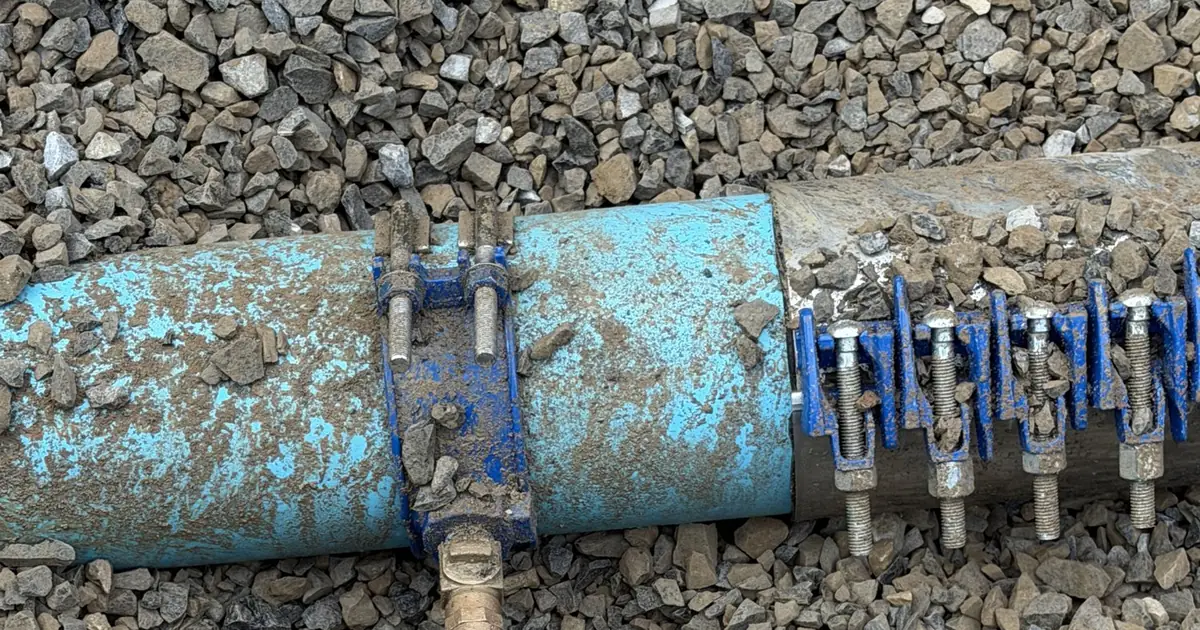
A water line break rarely picks a convenient time. It shows up as a wet spot that will not dry, a drop in pressure, a meter that will not stop spinning, or in the worst case a geyser in the yard. Whether it is a single home or a large property with many buildings, the first hour matters, and so does what happens before anyone starts digging.
This guide covers what property owners can do right away, why the excavation itself is more than just a hole, and what a good repair looks like when the work is finished. It is written for East Tennessee property owners, where hillsides, rock, and mountain driveways make utility repairs more involved than they look from the road.
First Steps When You Suspect a Break
You do not need a shovel to start. A few calm steps make the repair faster and safer:
- Find your main shutoff valve. Know where it is before you need it. Closing it limits the water loss and the damage to the ground around the break.
- Look at the meter. If every fixture is off and the meter is still moving, water is going somewhere it should not.
- Note what you see. Soft ground, pooled water, a sinkhole forming, or a sudden drop in pressure all help locate the break.
- Call your water provider. In many cases the provider is responsible for the line up to the meter and the property owner is responsible beyond it, but this varies by provider, so confirm who owns the section that failed.
If water is running across a driveway or road, or near electrical equipment, keep people and vehicles away and treat it as a safety problem first.
Why the Locate Call Comes Before the Dig
Water lines do not sit alone in the ground. Electric, gas, communications, and sewer lines can all run through the same corridor, and a bucket in the wrong place turns one problem into two. Tennessee requires a locate request to Tennessee 811 before excavating, with at least three working days' notice for planned work. If your situation is urgent, tell the 811 operator it is an emergency, since they can explain how urgent requests are handled.
This is also why the contractor you call should ask about utilities before they ask about price. A crew that starts by asking what is buried on your property is a crew that has done this before.
What Emergency Utility Work Looks Like
Emergency utility work is part of what we do, including main water line breaks. One recent example was a main line break at a large cabin resort. The call came on a Friday afternoon, the crew was on site until late that night to get the line under control, and we went back on Monday to patch and make sure everything held. The point is not the hours. It is that an emergency repair usually has two parts: the fast part that stops the problem, and the careful part afterward that makes the repair last.
We do not promise a response time here, because it depends on the property, the access, and what is buried around the break. What we can say is that Kyle Pope looks at the site himself and tells you what he sees.
Digging Is Only Part of the Repair
Once the line is located, the excavation has to expose the damaged section without damaging anything next to it. On East Tennessee ground, that can mean working around rock, steep banks, tree roots, or a narrow mountain driveway where the machine barely fits. The trench has to be safe to work in, the pipe has to be repaired or replaced correctly, and the material around the pipe has to be placed so it supports it.
After that comes the part people forget: backfill and surface restoration. A repair that is not backfilled and compacted properly can settle later, and a trench through a driveway has to be patched, not just covered. On a recent well house project, for example, we cut the existing driveway to bring utilities in and then returned to patch the asphalt. The same thinking applies to a water line repair: the job is not done until the surface is back to something you can drive on.
Planned Utility Work Is Easier Than Emergency Work
If a line is old, has failed before, or runs through a part of the property you are about to build on, replacing it on your schedule is usually less stressful than repairing it in a crisis. We handle major and minor utility installation as well as repairs, and we often coordinate it with other site work such as grading, foundations, and retaining walls so the trenches are cut once instead of twice. You can read more on our utility work page.
Questions to Ask Before You Hire Anyone to Dig
- Who is calling in the 811 locate, and when?
- Who owns the section of line that failed, and who needs to be notified?
- How will the trench be backfilled and the surface restored?
- Will I get photos as the work progresses?
- What happens if the crew finds something unexpected in the ground?
We send photos as the work moves along, so you can see what is happening on your property without standing in the trench.
Where We Work
We work across Sevier, Jefferson, Knox, Blount, and Hamblen Counties. If you have a utility problem or a planned project, send us a request and we will talk through what you are seeing.