
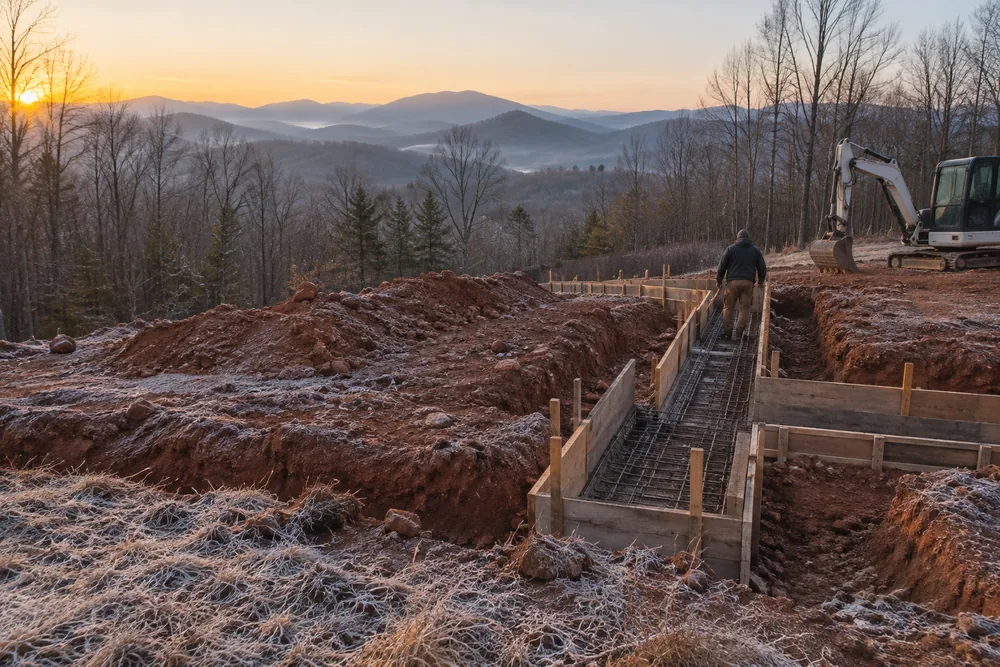
If you are planning a new home, cabin or addition in the Smokies foothills, you may be wondering whether winter shuts everything down. In East Tennessee, it usually does not. Winters here are mild compared with most of the country, and a lot of site work and foundation work can keep moving from November through February. What changes is the way the work is planned: the real enemies are rain, mud and the occasional hard freeze, not months of snow.
This guide explains what winter actually looks like in the Sevierville area, how cold weather affects concrete, and how to schedule a foundation so a few bad days do not turn into a few lost weeks.
What Winter Looks Like in Sevier County
NOAA's 1991 to 2020 climate normals for the Sevierville station give a useful picture. In January the average daily high is about 49 degrees and the average low is about 27 degrees. Lows at or below freezing show up on roughly 19 days in December and 21 days in January, while a day where the temperature never gets above freezing is rare, averaging under three in January.
Moisture matters more than cold. December is the wettest month of the year at that station, averaging about 4.9 inches of precipitation, and January and February each average more than 4 inches. Snow is a small part of that total, about an inch and a half in a typical January. Plan for wet ground more than frozen ground, especially on clay and on hillsides where water runs across the lot.
These are long-term averages for one station in the valley. A mountain lot above Gatlinburg or Pigeon Forge can run colder than the numbers above, so treat them as a starting point and watch the forecast for your own site.
How Cold Weather Affects Concrete
Footings, foundation walls and slabs all depend on concrete gaining strength before it freezes. The American Concrete Institute defines cold weather concreting as conditions where the air temperature has fallen to, or is expected to fall below, 40 degrees during the protection period. That is warmer than many people expect, and it means a crisp November night can matter.
A few points from industry guidance are worth knowing as a property owner:
- Fresh concrete can be damaged by a single freeze. Guidance from the American Concrete Institute is to protect concrete from freezing until it reaches a compressive strength of 500 psi, which the ready-mixed concrete industry puts at about two days after placement.
- Even in mild winters, plan for surprise freezes. The ACI guide says that in temperate climates in winter, concrete surfaces should be protected from unexpected freezing for at least the first 24 hours, or until the minimum strength is reached.
- The ground matters too. Surfaces that will touch the concrete should be free of ice and snow and above freezing before the pour.
- Protection is ordinary equipment. Insulated blankets, tarps, and straw covered with plastic are commonly used to hold heat in the concrete while it gains strength.
None of this makes winter pouring impossible. It means the day of the pour is chosen with the forecast in hand, with protection on site before the truck arrives, and with the understanding that a pour may be pushed a day or two when a hard freeze is coming.
Frost Depth, Inspections and Your Permit
Footings generally have to sit below the local frost depth, and that number comes from the building code a county or city has adopted, not from a general rule of thumb. Sevier County's building inspections office lists the 2024 International Residential Code and International Building Code among its adopted codes. Ask the building department which frost depth applies to your parcel before the footings are laid out.
Inspections are the other scheduling factor. The county lists footings among the typical inspections, and property lines must be marked for the footing inspection. A footing trench generally has to be ready for the inspector before any concrete goes in, so a rainy week that fills the trench with water can delay both the inspection and the pour. Build a few spare days into your plan around that step.
Dealing With Rain, Mud and Rock
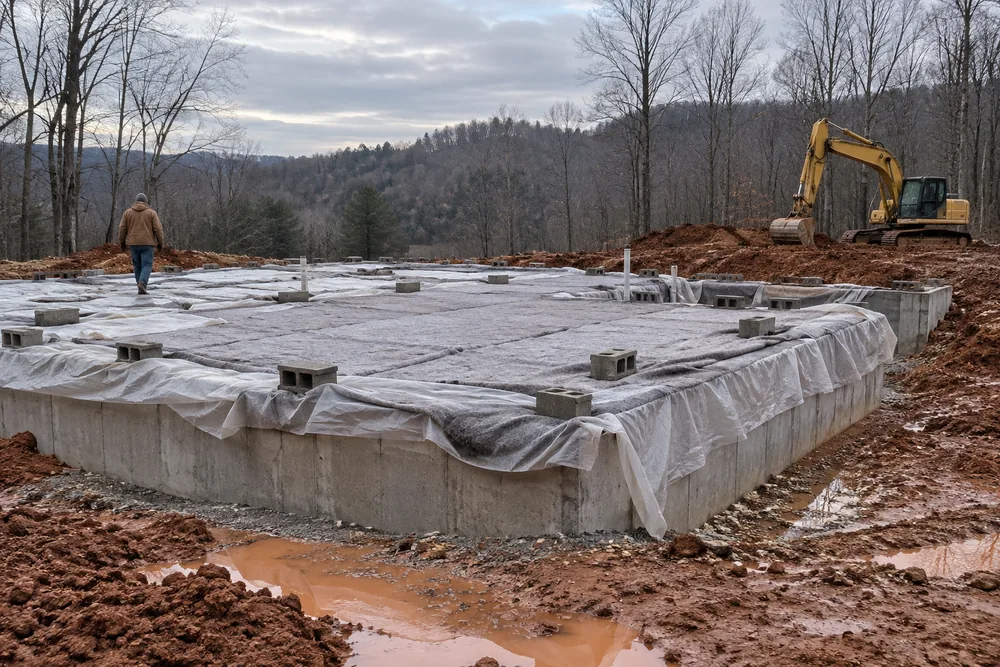
On most East Tennessee winter jobs, water is the bigger schedule risk. Wet clay is slow to work and hard to compact, and an open trench collects runoff. A few habits help:
- Plan where water goes before digging. Water runs downhill and into an open footer trench, so the site should be graded to move it away from the excavation.
- Do not backfill with frozen material. Engineering guidance for trench backfill is clear that frozen soil should not be used.
- Keep disturbed ground covered. Bare soil on a slope is vulnerable to a heavy winter rain. On sites that disturb an acre or more, Tennessee requires construction stormwater permit coverage, and smaller lots still benefit from the same basic erosion habits.
- Expect rock to slow things down. Much of our region is rocky. On the lots we work, rock is broken with a hammer attachment on the excavator, and that work is something we plan around cold and wet weather.
Scheduling a Winter Foundation
The most useful thing a property owner can do is separate the work that is weather-sensitive from the work that is not. Clearing, rough grading, hauling and utility trenching can usually keep moving through a normal East Tennessee winter. Concrete is the part that waits for the right day. Because we handle clearing, excavation and foundation work as one turnkey scope, we can keep the dirt work moving and set the pour for the best window rather than losing the whole schedule to one bad week.
A practical winter checklist:
- Confirm permits, the septic permit if you need one, and your inspection steps before the weather turns.
- Have the lot cleared and the pad shaped while the ground is workable.
- Make sure there is a stable way in for equipment and concrete trucks.
- Agree up front on who decides when a pour is postponed for a freeze.
- Keep a little flexibility in your move-in or framing date.
Frequently Asked Questions
Can you pour a foundation in winter in East Tennessee?
Often, yes. The key is protecting the concrete from freezing while it gains strength and choosing the pour day based on the forecast. Industry guidance calls for protection during the early days after placement, and that is usually done with blankets or tarps.
Does the ground freeze deep enough to stop excavation?
Freezing nights are common from December through February, but a long stretch of frozen ground is not typical in the Sevierville area. Conditions vary by elevation, so a mountain site may be different from a valley lot. The more common slowdown is wet, soft ground after rain.
How deep do footings need to be?
Footing depth is set by the building code your local jurisdiction has adopted and by what your plans call for. Ask your county or city building department, and follow the approved plans for your project.
What delays a winter foundation the most?
Rain and the resulting mud, followed by hard freezes on pour days and rock that needs breaking. A schedule with a few flexible days handles all three better than a rigid one.
If you are planning a foundation for this winter or spring, tell us about your lot. Reach out through our contact page to request a quote, and we will set up a time to look at the site and talk through the sequence.